Convergence of Random Variables
This section collects the core modes of convergence used throughout the Probability Prelim Survival Guide.
Each mode is defined, interpreted, and connected to its most common proof techniques and use cases.
The goal is recognition and triage, not re-proving theorems from scratch.
Convergence Hierarchy
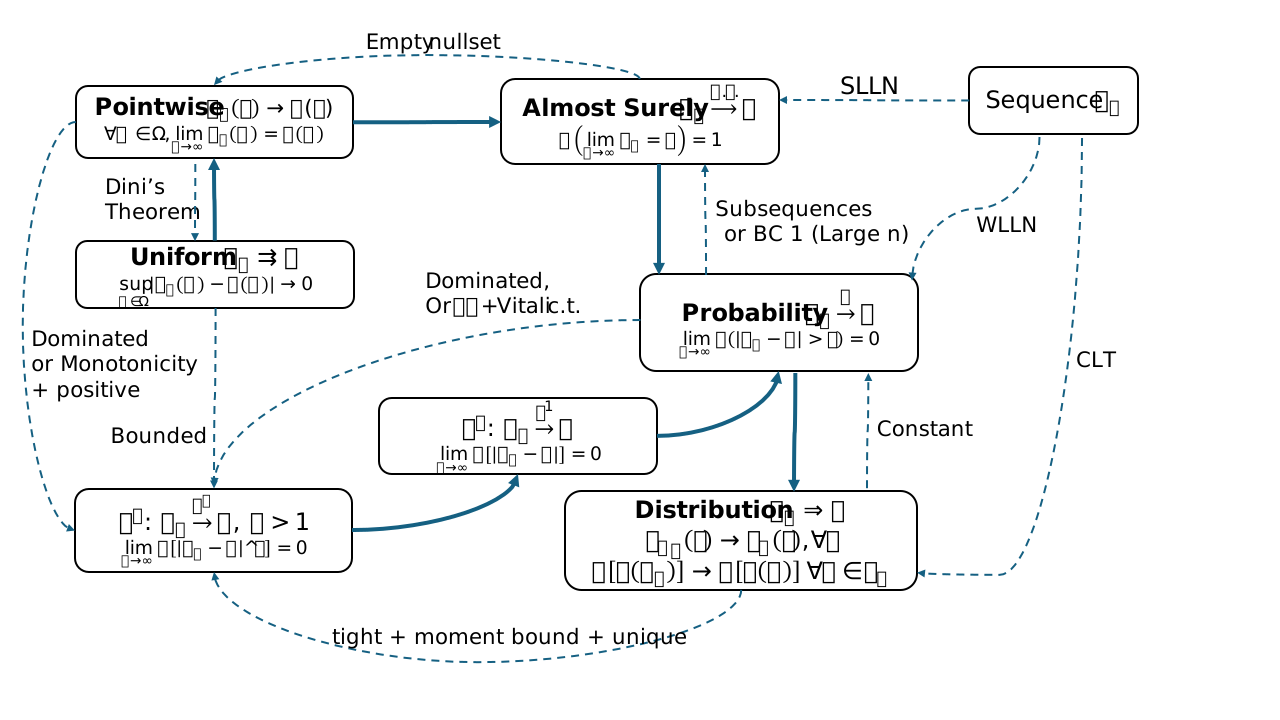
The standard strength relationships are:
\[X_n \xrightarrow{\text{a.s.}} X \;\Rightarrow\; X_n \xrightarrow{L^p} X \;\Rightarrow\; X_n \xrightarrow{p} X \;\Rightarrow\; X_n \xrightarrow{d} X\](Implications are one-way in general.)
Included Topics
This section includes concise review entries for:
- Almost sure convergence (a.s.)
- Convergence in probability
- Convergence in distribution
- $L^p$ convergence (with special focus on $L^1$ and $L^2$)
- Laws of Large Numbers (Weak and Strong)
- Central Limit Theorem and Delta Method
- Borel–Cantelli lemmas
- Uniform Integrability
- Dominated and Monotone Convergence Theorems
- Characteristic function methods
- Slutsky’s theorem and Continuous Mapping Theorem
How to Use This Section
- Use this as a navigation hub when a problem asks “what kind of convergence is this?”
- Match the statement being asked to the strongest applicable mode.
- Then drop to the specific theorem or tool needed (LLN, CLT, BC, UI, etc.).
This section is designed to support fast identification under exam pressure, not exhaustive proofs.
Comments